

Today is the seventh of my eight day series where I rank a group of eight historical figures on a scale of S to D (superb to terrible) based on how well they succeeded in their duties and/or goals, their skill in battle, and by what we know (if anything) about their general personalities as normal people.

Previously, we have covered Henry VI, Edward IV, Queen Margaret, Richard, Duke of York, Somerset, and Warwick. Today, I’m going to be covering the last of the Yorkist kings and one of the most controversial ones–Richard III. As always, these are just my opinions. You may have an entirely different perspective–and if you do, feel free to share it in the comments!
Richard III
I’ve never read Shakespeare, so coming into my study of the Wars of the Roses, my only knowledge of Richard III was from my interest in the Princes in the Tower, Richard’s two nephews who he locked in the Tower of London (and, as many believe, presumably murdered. There is debate on this, however, and Philippa Langley (the historian who found Richard III’s bones) has some really compelling arguments against his involvement in the murder. You can listen to those here).
The more I learn about him, though, the more intrigued I am. Especially when questioning the reasons why he usurped the throne as he did. Which is of course my first subject to rank–Richard III’s success in his goals.
Richard, of course, is the Duke of Gloucester before he becomes king, and, upon Edward IV’s sudden death, Richard is presumably given charge of the kingdom as a Protector, since Edward’s son and heir, Edward V, is only twelve years old. However, Edward V’s Woodville relatives completely disregard Edward IV’s will and want to crown Edward V immediately.
One thing about Richard III is that he always seemed loyal to Edward IV, and subsequently, it seems he wanted to follow his wishes. However Edward V was attached to his Woodville relatives, and Richard III essentially had to form a coup to get him from them. Upon realizing that Edward V may want to enact vengeance upon him once he’s crowned king for his actions, Richard pushes the coronation date back again. This alienates some allies who start fearing Richard III is getting ambitions for the throne–which is exactly what happens. Richard III is successful in claiming (or usurping) the crown–but can he keep it?
Richard’s short rule is rife with political turmoil. No longer are there two sides–Lancastrian or Yorkist. The Lancastrians have essentially been wiped out, save for one minor nobleman across the sea in Brittney named Henry Tudor. But now the Yorkist camp is split in two, with many Edwardians–those supporting Edward IV’s will and thus his son’s claim to the throne–fleeing to Brittney along with a large chunk of the Woodville camp and their supporters. As the princes in the tower are presumed dead, they start backing any candidate who isn’t Richard for the throne–and the shiny prospect of Henry Tudor comes into the forefront.
There are a few uprisings in England during Richard III’s reign which he is able to put down successfully, but throughout most of it, he’s paranoid about Tudor and suffers several personal tragedies, including the deaths of his only son and heir from illness and later, his wife.
And then, of course, we have the Battle of Bosworth. Richard had a pretty flawless military record from his time as Duke of Gloucester, as he fought in battles such as Barnet and Tewkesbury, and it seems his tactics at Bosworth were just as smart as they’d always been. The deciding factor as no fault of Richard’s, but merely of a third army–that of the Stanleys, taking the side of Henry Tudor late in the battle. Richard III died in the battle, the last British king to do so.
So in terms of success–I mean, he usurped the throne and ruled for two years, but ultimately Henry Tudor won the crown, creating the Tudor dynasty most people know of. So I guess I have to give him a solid five out of ten–he succeeded at first, but quickly failed.
In his abilities as a warrior, chroniclers wrote about his courage and skills. He was taught by Warwick, and nothing negative could be said about his actions even at Bosworth, where he fell bravely fighting in the field. And if the Stanleys had sided with him, maybe things would have gone differently for him.
Whatever the case, I have to give him a nine out of ten for his warrior skills.
Personality is the toughest to nail down for a lot of these figures, I think. Chroniclers did write he had a sharp wit, was intelligent, cautious, and acted decisively, along with the “fierce courage” he possessed. During his reign, however, he seemed to take his cautious nature too far, bordering into paranoia.
Yet he was also similar to his father in that he wanted justice for all people, especially the poor, enabling the justices of the peace to act to that effect. He rarely took gifts of money, but instead gave it back to those who gave it to him, paid off debts, and taxed foreign merchants over British ones (with the exception of writers, bookbinders, and printers, whom could come from anywhere without paying increased taxes, probably to help boost learning in England).
I think his most obvious trait, and perhaps a possible reason behind why he usurped the throne, was his loyalty to Edward IV, and maybe by extension, some of his other family members (namely his brother George, Duke of Clarence and cousin Warwick). Let me explain.
First and foremost, Richard was always on Edward IV’s side even when Warwick and George rebelled against him (as mentioned in Warwick’s post). Richard’s initial motivation for seizing control of Edward V as well was to fulfill Edward IV’s wishes. So it doesn’t seem like Warwick and George would have a part to play in Richard III’s motivations. But when you think about who controlled Edward V, things make a little more sense.
Who were the people who shoved Warwick out of favor with Edward IV? Who were the people who collected the evidence and pushed Edward IV to kill (murder?) his own brother, George? The Woodvilles–and probably specifically, Elizabeth Woodville, who may have also been behind yet another murder of someone who didn’t approve of her marriage with Edward.
Perhaps it was more of an anti-Woodville sentiment than anything. But I think, perhaps quietly, Richard blamed the Woodvilles for the disintegration of the relationship between Edward IV and their mentor Warwick, and for the death of his brother, George.
Whatever the case, Richard is a mixed bag when it comes to personality as well. I did appreciate his more progressive mind when it came to the justice system, and his loyalty was commendable, at least at first, but his paranoia did mar the latter part of his reign. Regardless, though, I think I have to give him a solid seven for personality.
Success: 5
Warrior Skills: 9
Personality: 7
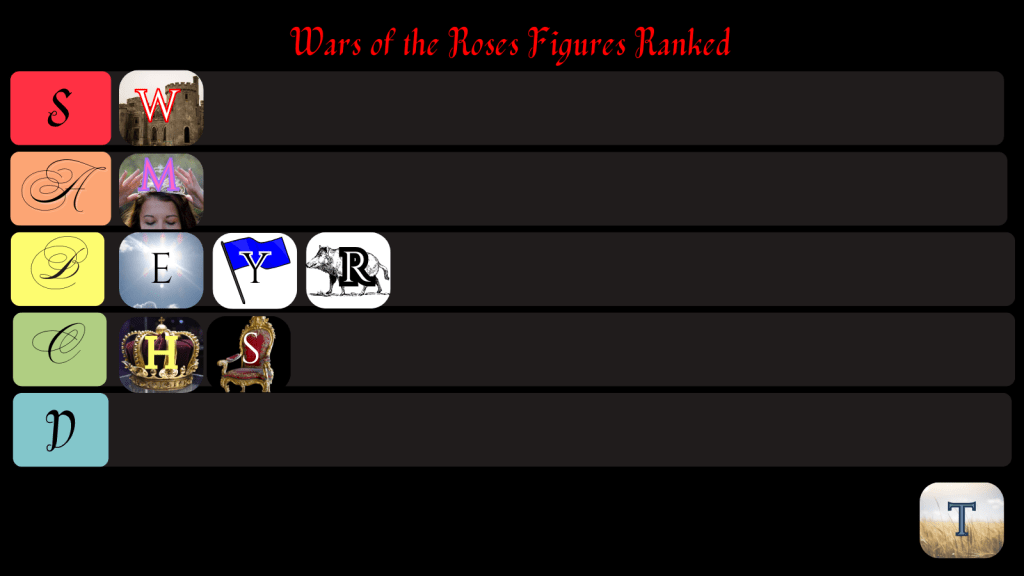
Ugh. This is hard. In light of everything, I probably have to give him a B in ranking. An upper B like his father and brother, but still a B. Must run in the family, I guess!
What do you think of my ranking? Do you think it’s accurate, or would you have placed him somewhere else? What fact do you find the most interesting? Would you like me to write a post someday on the theories of what happened to the Princes in the Tower and what I think most likely happened? And finally, how do you think I’ll rank our last historical figure, the man who ultimately came out on top in the conflict, Henry Tudor? Let me know in the comments below! ~ Kay Adelin
Discover more from Kay Adelin
Subscribe to get the latest posts sent to your email.


2 thoughts on “Ranking History: The Wars of the Roses Historical Figures: Richard III”