


Today is the sixth of my eight day series where I rank a group of eight historical figures on a scale of S to D (superb to terrible) based on how well they succeeded in their duties and/or goals, their skill in battle, and by what we know (if anything) about their general personalities as normal people.
Previously, we have covered Henry VI, Edward IV, Queen Margaret, Richard, Duke of York, and Edmund Beaufort, Duke of Somerset. Today, we’re covering a hugely important (and fascinating) character who drives much of the later events in The Wars of the Roses, Richard Neville, Earl of Warwick.
I’m going to be entirely honest and admit I’ve already known where I am going to rank Warwick since the beginning of this series. I may or may not be slightly biased toward him–okay, maybe a lot–but he’s such a fascinating character, and who else can boast about deposing and making two kings? And come on, he’s got such a cool moniker–The Kingmaker.
Anyway. Just a warning that this post is a lot bit longer than the others. Especially because this guy had a lot of success I’ve got to cover. And as always, these are just my opinions. You may have an entirely different perspective–and if you do, feel free to share it in the comments!
Richard Neville, Earl of Warwick
Richard Neville, Earl of Warwick, was the son of (yet another) Richard Neville, Earl of Salisbury. Thus why most historians call them Warwick and Salisbury instead of Richard Jr. and Richard Sr. (We’re already dealing with too many Richards during this time, anyway, so we’re going with Warwick.) Warwick actually received the earldom of Warwick through his marriage to the earldom’s heiress, Anne Beauchamp.
Warwick’s success level is quite hard to pin down, mostly because of everything we have to consider. Since Warwick was known as a great political mover and warrior, I’m going to focus on both of those at the same time.
In the grand scheme of things, Warwick is pretty quiet in the beginning. The Neville family was involved in a family feud with the Percy family, most likely because the Percy family grew threatened at the Neville family’s growing power in the north of England, where the Percys made their home. The feud essentially blew into a full blown civil war in the north during King Henry’s illness in 1453. As it took place between the two most powerful lords in the north, only Henry had the authority to stop the feud, but since he was incapacitated, it drug on. York tried to work out peace between them, but it was unsuccessful.
It was only in 1455, after Henry regained his senses, did Warwick become a massive player on the political board of England, and he did so magnificently at the First Battle of St. Albans. Warwick and his men broke the walls of the city first, and then Warwick took a flanking party through the streets and to the place where the royal party was amassed, shouting their battle cry of “Warwick, Warwick, Warwick!” The king’s party was taken by such surprise that the king himself was injured by an arrow and later captured by York, Salisbury, and Warwick. The three requested Henry take them as his loyal subjects, which he had little choice but to do, and when they arrived back in London, Henry sat beside York, Warwick, and Salisbury.
Warwick earned the Captaincy of Calais from the aftermath of this, and also was a successful pirate, destroying a Spanish merchant fleet in 1458 during a financial crisis at Calais.
But as time passed, Queen Margaret slowly regained power, eventually attainting Warwick, Salisbury, and York for the events at the First Battle of St. Albans. A further betrayal from one of the Calais garrison captains Warwick brought back to England with him forced the three, along with York’s two eldest sons, Edward and Edmund, to flee England. Warwick, Salisbury, and Edward fled to Calais, while Edmund and York went to Ireland.
Despite this failure Warwick unintentionally brought upon the Yorkists, he did manage to patch things up pretty well. Not only did he retain control over Calais (easily repulsing the man Margaret sent to replace him) but thanks to his skill in piracy, he abducted nobles sent to attack them and destroyed the ships they were building to be used against them before they were completed. Probably his largest success at this time, however, was his ability to keep communications going between Salisbury, Edward, and himself at Calais and York and Edmund in Ireland.
Shortly thereafter, Warwick, Salisbury, and Edward returned to England with a force, their landing secured by Warwick’s brother who still lived in England. The trio eventually secured London and captured King Henry. Only then did York return and declare his right to kingship. These events were probably a testament to Warwick’s ability to keep up communications so well, as no doubt everything had been orchestrated beforehand.
Warwick’s role in getting York to declare his kingly ambitions, however, is questioned. Some think Warwick pressed him to do this, whereas others believe Warwick just suspected York’s intentions and let him have at it. Personally, I’m of the latter opinion, though I could certainly see the former as well.
Obviously York never lived to see his kingly ambitions fulfilled, and after his death came another of Warwick’s failures at the Second Battle of St. Albans, where Warwick not only lost, but also was forced to flee so quickly, he left behind the prisoner-king Henry.
I do think failure had a role to play in motivating Warwick, though, as shortly after this failure, he joined forces with Edward’s army for the notable Battle of Towton, at which they won a crushing victory. Afterwards, Edward was crowned king and Warwick richly rewarded with vast lands and wealth
Warwick also successfully put down the remaining rebellions against Edward in the north, of which there were many. With each defeat, he grew more rich and powerful—arguably, more powerful than Edward himself. And if the story ended here, maybe Warwick could’ve had a better ending—although he wouldn’t have received the awesome moniker “the Kingmaker”.
Warwick’s biggest failure (other than the Battle of Barnet, arguably) wasn’t really even something he could control. When he and Edward finally found themselves able to focus on foreign policy, they found they each supported two opposing policies. Edward, being king, refused to bend on his policy and won out, though he seemed to try to humor Warwick by letting him pursue his policies before pulling out at the last moment (which made Warwick feel like a fool). Edward’s marriage to Elizabeth Woodville and her and her family’s impertinent behaviors and marriages, including several insulting marriages to members of Warwick’s own family (look up the Diabolical Marriage–even people in that day were horrified by it) made things worse. Warwick seemed to swallow these bitterly—and yet, Edward would not permit the single marriage Warwick desired between his daughter and Edward’s brother George.
That was the final nail in the coffin for Warwick who proceeded to return to his estates, supposedly to sulk. However, he wasn’t sulking. Instead, he was fomenting a popular rebellion against Edward and luring Edward’s brother George to his side. Not only did Warwick get his daughter and George married, but the popular rebellion succeeded—he killed several of the Woodvilles and captured Edward and kept him imprisoned for a brief time.
Perhaps in an inadvertent way, though, Warwick’s success in this rebellion was also the start of his greatest defeat. Warwick couldn’t keep Edward imprisoned at a time when the government relied so heavily on the shoulders of a king, and so was forced to release him. At this point, Edward moved against him and his family, subtly diminishing Neville power and prompting another—this time, unsuccessful revolt from Warwick and George. Warwick and George fled to Calais, but for the first time, the garrison shut its doors to him, forcing them to find sanctuary in France—where the most unusual alliance of that time, and maybe of the medieval time itself, occurred.
Warwick allied himself with Queen Margaret. Her son, Prince Edward, married Warwick’s only other daughter Anne, and Warwick united the might of the Neville family once more, this time behind the Lancastrians. He had such success, Edward IV narrowly avoided capture, leaving behind his wife and children. Warwick restored Henry VI to the throne in what is known as the Readeption, and earning him his famous moniker, “the Kingmaker”.
But like Warwick, Edward wasn’t one for sulking, and he returned. His mother, sisters, and youngest brother Richard coaxed the wayward George back into their camp, and London, much to Warwick’s surprise, opened their gates to him.
This resulted in Warwick’s final defeat at the Battle of Barnet—although I blame the weather more than anything Warwick did. Fog coated the field so heavily, the two forces lined up unevenly. Not only that, but Warwick’s force mistook the badge of one of their own, Oxford, as Edward’s, and started attacking one another. Warwick, who had been encouraged by his brother to fight on foot to show Neville courage and not on horseback like he preferred, tried to escape in the resulting chaos, but was tracked down and killed in the woods.
In light of all this, Warwick’s success rate is really hard to rank, because, like Queen Margaret, Warwick ultimately lost. But two of the times he lost was no fault of his own (such as the betrayal by one of his Calais garrison captains and his fatal Battle of Barnet in 1471) and because his successes far outweigh his losses, I’ve got to give him a nine out of ten.
Warwick’s skill as a warrior here is also shown. There are some chroniclers who said he liked to fight on horseback because he was then able to flee and save himself if things turned out badly. In that time period, that was considered cowardly, and maybe it still is since he didn’t order his men to retreat either but was just concerned about saving himself. But if he didn’t run at, say, the Second Battle of St. Albans, he most likely would have been killed and would not have been able to secure Edward’s kingship or his own heights of power. And he was clearly not too much of a coward if indeed he was one, looking at all the battles and piracy he was involved in. So I have to give him another nine. This guy was brilliant, even if perhaps overly ambitious.
Warwick’s personality is probably the hardest thing to pin down, as well as the most controversial. Some people think he was downright power-hungry, wanting to control Edward. Some think he was just power-hungry in general; most agree he was overly ambitious.
Personally, I like to take a step back and think about a what-if scenario when dealing with Warwick. What if, instead of Edward, Richard of York had become king? Would the events that transpired after Edward’s ascension to the throne had happened with York? Would Warwick had become power-hungry still?
Personally, I believe Warwick was ambitious, probably overly so. But I also believe he just wanted respect, and Edward wasn’t giving it to him. If Richard of York had ascended the throne instead, I find it hard to imagine Warwick repeating the events he did under Edward, solely because I believe York knew how to treat his allies. I’m sure Warwick’s ambitions would’ve had to be curtailed somewhat, but I think York would have been able to do it in such a way that didn’t constantly humiliate and insult Warwick, and certainly the offensive Woodville marriages wouldn’t have happened.
Was Warwick a proud man? Certainly very much so. He was probably overconfident as well, and, personality wise, he did seem like a man who liked to be in control. But he never made a bid for the throne and, while York was alive, he never seemed inclined for more power. Which again, I believe lends itself as proof that Warwick wanted respect. He was a proud man, and, in many cases, rightfully so. He did win the First Battle of St. Albans. He was the one who singlehandedly ensured communications with York in Ireland. He and his family essentially put Edward on the throne. If Edward had treated him with the respect he deserved for the deeds he did (while, of course, not giving him every single little thing he wanted if it was not in line with what was good for the kingdom), I think Warwick would’ve stayed a loyal ally. I also think that’s why, despite Edward’s shower of lands and offices, Warwick still did what he did. He didn’t want Edward’s money and commissions, he wanted his respect and gratitude for everything he did and suffered for him.
Outside of his relationship with Edward, he was known to be a charming man, popular and a genius at creating propaganda. London typically always liked him, and Calais harbored him against Henry when they were attainted. But he also had some great enemies, like the Percys, the Duke of Exeter, Somerset, and the like.
I’m also not sure he always thought ahead at the larger picture, especially in light of his later decisions. In some of his rebellions, such as when he captured Edward, it almost seems like he didn’t know what to do or didn’t think the whole thing through as to how he intended to go on once he did succeed in his present goal.
So for personality-wise, I’ve got to give him an eight. As a writer, there are things known as fatal flaws, and I think Warwick’s fatal flaw wasn’t so much his ambition or overconfidence, but I think it was his pride. He believed he should be treated a certain way, and when he wasn’t, he believed he was strong enough to make it happen. Which, in many cases, he was, but ultimately, it cost him his life.
Success: 9
Warrior Skills: 9
Personality: 8
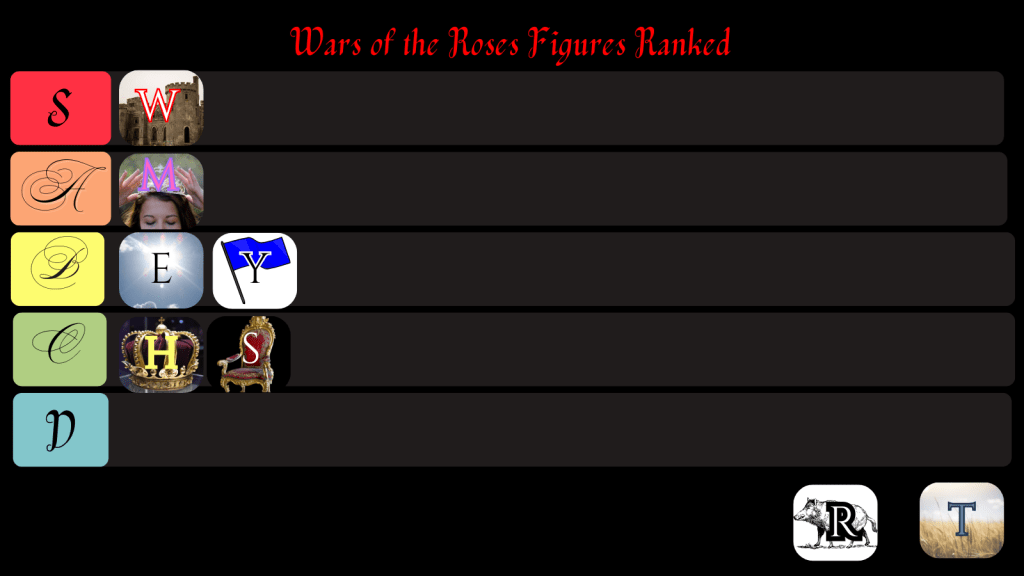
As I said at the beginning, I already knew where I was going to rank Warwick coming into this post. And like, where else is there to put him but the S ranking? (Okay, yeah I know this is a controversial issue but hey, it’s my ranking tier so I can put him where I want! Heh.) Plus, come on. Look at everything he actually did. It’s amazing what he was able to accomplish, even if you don’t like him.
What do you think of my ranking? Do you think it’s accurate, or would you have placed him somewhere else? What fact do you find the most interesting? How do you think I’ll rank the next historical figures? Let me know in the comments below! ~ Kay Adelin
Discover more from Kay Adelin
Subscribe to get the latest posts sent to your email.


I’ll admit, I was today years old when I researched The Diabolical Marriage. What the heck…
LikeLiked by 1 person
IKR, and people back then had the same reaction xD Warwick had hugely legitimate reasons for rebelling against Edward IV, ngl xP
LikeLiked by 1 person
Fr.
LikeLiked by 1 person