

It’s the third of my eight day series where I rank a group of eight historical figures on a scale of S to D (superb to terrible) based on how well they succeeded in their duties and/or goals, their skill in battle, and by what we know (if anything) about their general personalities as normal people.
So far, I’ve ranked both Henry VI and Edward IV, two of the largest players in The Wars of the Roses. But today, I’m going to be ranking the true power behind the Lancastrian faction of the wars–Margaret of Anjou, or Queen Margaret. As always, this is just my opinion on her. You may have an entirely different perspective on her–and if you do, feel free to share it in the comments!
Margaret of Anjou (Queen Margaret)
Margaret of Anjou, the power behind the Lancastrian cause. Talk about a strong medieval woman! But as a woman, her definition of “success” in her role takes on a little different aspect than that of her male counterparts, merely because of the medieval culture in which she was born.
While she was a queen, her chief role was not to rule–that was the king’s job. She could and did, of course, wield considerable power, but most of that power was consolidated through her role as her son’s guardian. So I will be looking at her success not as how good she was as a ruler, but how successful was she as a wife and mother–which was and still is, a hugely important role for women. And, in Margaret’s case, it was the main motivation for many of her most important actions.
Margaret, as queen, proved herself to be quite brave and creative. During the early part of the 1450s, a popular rebellion known as Jack Cade’s Rebellion, arose and took over London. Henry and his advisors fled, terrified–except Margaret remained in her manor near London and helped to successfully break up the major part of the rebellion by offering the rebels charters of pardon and disperse. As Henry’s wife, she often supported him by raising armies on his behalf and advising him, especially after Henry’s two favorites, Suffolk and Somerset, were killed.
But I think as a mother is where Margaret’s main role lie, and she knew it. During the Wars of the Roses, she was constantly fighting for her son’s right to the throne. After Somerset, she became Richard of York’s chief enemy because York arranged for himself to be Henry’s heir, disinheriting her and Henry’s son. She raised armies in her son’s name, sent armies out to fight under his banner, and almost everything she did during the course of the Wars of the Roses was for her son’s sake, not so much Henry’s.
Seeing as she ultimately failed to return her son to the throne, her success ranking on this will have to be lowered. However, she did everything she could do in order to try to make it a reality, and truly cared for her son’s future, so as a mother, I feel she was quite successful in what she could control. So I’ll give her a nine on success–docking one point for its ultimate failure.
What about her as a warrior? Again, because she’s a woman and women rarely went into battle themselves in the medieval times (though some did!) I’m going to be looking at this from a little different angle from her male counterparts. Margaret raised armies. She was the power behind them, although she often delegated their actual leading to her strongest male supporters, such as Northumberland, Somerset, and eventually, Warwick and her own son, Prince Edward. For example, in 1460, while in Scotland, Margaret contacted all her allies in England, including Northumberland, Somerset, and Devon, to form an army. But since she could not pay all these men, she allowed them to plunder and loot their pay, a creative, if not downright cruel way to solve the problem. And this army here is the one which ultimately killed her greatest foe (at the time), Richard of York in the Battle of Wakefield. They also routed Warwick’s force (who held King Henry captive) ultimately freeing the king, at the Second Battle of St. Albans.
So for her warrior skills, which I would count as her ability to unify and create armies, despite not leading them, I’d have to give her a ten out of ten. She did this masterfully, multiple times.
You can probably already see some of Margaret’s personality in some of the prior examples. As one chronicler put it, “she was more wittier than the king”. She even created a secret code for her and Henry to use in letters so she would know if he was truly the author of them. This code served her well, as many times forged letters were sent to her, directing her to take Prince Edward here or there, probably to be captured.
Margaret was certainly the opposite of her quiet, weak-willed husband and was certainly better cut out for ruling than he was. However, she was a woman, and due to the times, a woman could not rule. Not only that, but she was a Frenchwoman, and England was just coming out at the losing end of The Hundreds’ Year War with France. When Henry VI experienced his first attack of insanity in 1453 which lasted for fifteen months, Margaret tried unsuccessfully to wrestle power away from Richard of York and wield it herself. However, the fact that she fought for power shows she had spirit–but also may not have acted as wisely as she should have, if she wanted to calm things down and make the lords more favorable towards a woman ruler.
She was also most certainly much of the problem when it came to “Henry’s” treatment of Richard of York (Henry’s name being in quotations because it was most likely her or Somerset controlling him depending on the time). For example, after the Battle of Ludford Bridge (though I’m not sure why it’s called a battle?) when a betrayal forced York and his allies to flee, leaving behind his wife, two youngest sons, and his city of Ludlow to the mercy of the Lancastrian army, one chronicler wrote, “Every lord in England at the time durst not disobey the Queen.” The queen was the one who despised York and probably pushed for him and his allies to be attained, forcing the issue to rise from fighting over who advised the king to an actual dynastic struggle in which her son was disinherited and ultimately killed.
So she was a strong willed woman with courage, but also who held grudges and allowed men to loot (and worse) from innocent people if they’d fight for her. I’ll have to give her a seven for personality, only because I can see where and why she’d make some of the decisions she did, but also areas where she could have used her power to solve problems and dissolve issues, but instead she helped to enlarge them, ultimately resulting in her greatest failure of not securing her son’s throne.
Success: 9
Warrior Skills: 10
Personality: 7
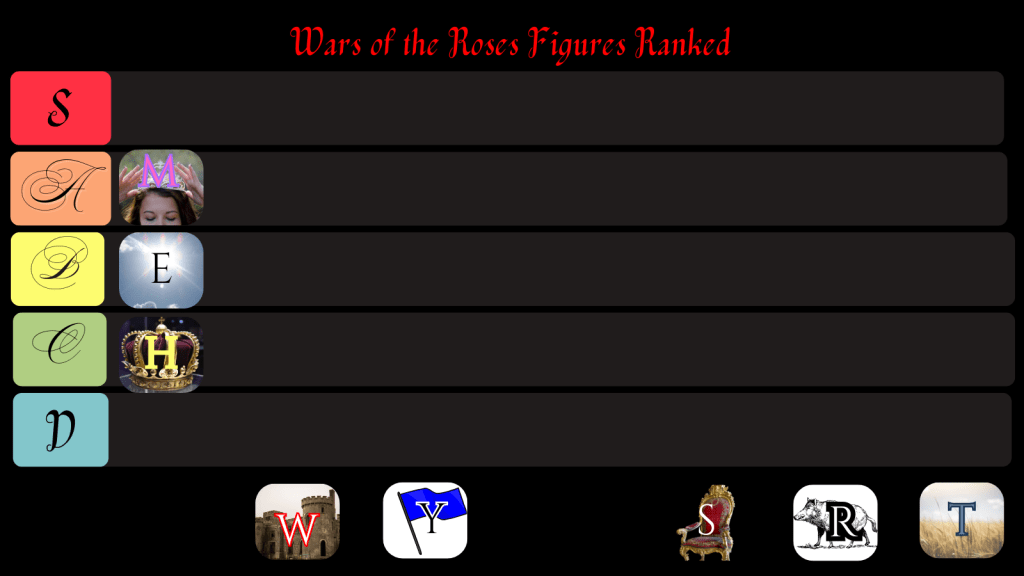
Margaret certainly is a notable medieval woman. She was strong, knew what she wanted, and wasn’t afraid to use all her resources to get it. She was also quite intelligent, but she held grudges which may have ultimately destroyed her and her family. She’s certainly not an Eleanor of Aquitaine level of a medieval lady, but she’s close, quite close. So I think I have to put her in the A category.
What do you think of my ranking? Do you think it’s accurate, or would you have placed her somewhere else? What fact do you find the most interesting? How do you think I’ll rank the next historical figures? Let me know in the comments below! ~ Kay Adelin
Discover more from Kay Adelin
Subscribe to get the latest posts sent to your email.

 Kay Adelin
5 thoughts on “Ranking History: The Wars of the Roses Historical Figures: Queen Margaret”