

Today is the fifth of my eight day series where I rank a group of eight historical figures on a scale of S to D (superb to terrible) based on how well they succeeded in their duties and/or goals, their skill in battle, and by what we know (if anything) about their general personalities as normal people.
Previously, we have covered Henry VI, Edward IV, Queen Margaret, and Richard, Duke of York. Today, we’re covering the man whose rivalry with York started the Wars of the Roses: Edmund Beaufort, Duke of Somerset. As always, these are just my opinions. You may have an entirely different perspective–and if you do, feel free to share it in the comments!
Edmund Beaufort, Duke of Somerset
Edmund Beaufort became the Duke of Somerset in 1448 and was killed at the First Battle of St. Albans in 1455, so Somerset had a quick rise to power and destruction. Because of this, he might be a harder figure to type, but I’m still going to try, as it was his rivalry with York, who I ranked yesterday, which was a leading cause of the Wars of the Roses.
As mentioned yesterday, Somerset replaced York as Lieutenant of France in 1446, but dithered away in England until spring of 1448, when he was made duke. Shortly thereafter, due to some bad military decisions and other factors, the war with France swiftly goes downhill and English power in France is broken. This directly impacted England itself, triggering the rebellions and murders in 1450.
Somerset, being the Lieutenant of France during this time, could be blamed–however it was the bad decision of Henry’s current favorite, the Duke of Suffolk, which caused the initial problems. Suffolk was subsequently murdered in 1450, therefore those wishing to shift blame would only have to look at Somerset and blame him–which is what York did, probably still steamed over the Beaufort family undermining his authority when he was lieutenant of France. But other than Somerset’s seeming reluctance to travel to France to take up his post as lieutenant, there was really no obvious hints that things he did or didn’t do caused the fracture of English power. Personally, I’m of the opinion that Somerset was at the wrong place at the wrong time–and yeah, maybe he could have acted quicker, but York himself took two years to travel to Ireland upon receiving his commission, so York couldn’t judge him there.
Still, Somerset technically failed in his lieutenancy since these events happened under his watch, so some small measure of this must be taken into consideration. However, Henry apparently didn’t care, as, upon the death of his previous favorite, Suffolk, Somerset became his new favorite, swiftly being awarded the post of Constable of England, the highest military post in England. (This of course infuriated York who couldn’t believe the man under whose watch British authority in France crumbled would be given the highest military post in England.)
However here, Somerset did have some small success, as he managed to put down the major rebellion of 1450, stamped out another, and settled a longstanding feud between the Courtaney and Bonville families. And after York’s failed attempt at pressuring the king to imprison Somerset in 1452, Somerset became quite bold, making judicial proceedings against York and his allies, stripping York of his lieutenancy of Ireland, and having Henry become much more active.
There were some bumps in the road for Somerset–he was imprisoned by York in the chaos in the aftermath of Henry’s first mental illness in late 1453 and remained in prison for all 1454, but in the early days of 1455, Somerset was released by the recovered Henry’s orders. Hereafter, Somerset reversed almost all of York’s doings, stripping him of his posts, authority, and, to York at least, his dignity.
It’s only when York and his Neville allies raised a massive army in spring of 1455 did things go severely downhill for Somerset, and in an almost comically swift way. The very morning of his death, Somerset was stripped of his post as the constable of England in order to try to appease York–but at this time, York figured he’d never have peace with Somerset alive and demanded his life. Somerset and the other leaders stalled for time, and Warwick’s men grew tired of waiting. Warwick and his men decided to flank the city, catching Somerset and the others completely unaware, beginning the battle later known as the First Battle of St. Albans. Around midday, Somerset was dragged from a tavern he was defending and killed, while his son and heir was so badly injured, he had to be dragged from the battlefield on a cart.
So when I consider Somerset’s success, I must consider his lieutenancy of France and his role as Henry’s favorite. Clearly he failed in France, although most of that did not seem to be directly his fault, but in his role as Henry’s favorite, he was surprisingly successful. Only during Henry’s illness was he powerless–but even then, he possessed a network of spies who kept him up to date on all York’s doings. And he just kept popping back up, to the point where York realized he couldn’t just imprison him, he had to get rid of him if he was to ever have any peace.
So I think success-wise, I must give Somerset an eight of ten. He died in the end for it, but he never lost favor with Henry. And I suppose he might’ve been pleased to hear that it was in a battle seeking revenge for the lives lost at the First Battle of St. Albans that York himself was captured and subsequently killed.
As for his skill as a warrior–well, before becoming duke, Somerset had some military success in France, but it seems upon his becoming duke and lieutenant of France, his warrior skills went downhill. He only had the defeats in France and his own death in the First Battle of St. Albans to his name. At least at the First Battle of St. Albans, Somerset showed he wasn’t a coward despite being caught unawares by Warwick and his men by attempting to defend himself in a tavern and putting up a fight. But honestly, I’ll have to give him a ranking of two, because I’m focusing on his success during the events of the Wars of the Roses and as the Duke of Somerset, not before.
As for personality, there are a few interesting accounts of what he may have been like. One is when he was imprisoned, as mentioned before, he had a great network of spies and agents, with men posing as friars and shipmen to gather information for him. He also clearly had a vendetta against York, though the feelings were mutual.
Somerset may also have not been as religious as the normal person was in medieval times–that, or he was just so set on hurting York in whatever way possible, he wasn’t thinking straight. The reason for this was York’s chamberlain, one of his closest servants, was accused of attacking Somerset by a man who was then subsequently attacked. York’s chamberlain fled to a church for sanctuary, but Somerset sent men to break into the church and drag the chamberlain out. This was highly illegal and looked at as seriously offensive to God, and Somerset was forced to return the chamberlain within forty-eight hours.
This singular event also marked the beginning of a serious escalation in the feud between York and Somerset, culminating in 1455 when York and his Neville allies formed a massive army, causing Somerset to panic. Maybe Somerset knew his luck had run out and that he pushed too hard against York. Whatever the case, it seems he attempted to repeat the events of 1452–when York failed to convince the king to imprison Somerset and instead was humiliated–but York was wiser this time and refused to fall for it.
But clearly Somerset had ways of inducing loyalty and was likable to the right people–Henry and Margaret clearly enjoyed his company, and Somerset’s own son spent much of the latter part of the Wars of the Roses seeking to avenge his father’s death.
I think these events show us that Somerset was shrewd, opportunistic, held grudges, did not act the best under pressure, and at the very least either didn’t think straight when angry or was irreverent of God–but also inspired loyalty and was loved by several others. I think if you were on his side, he’d make a loyal friend, though maybe a tad hotheaded, but if you disagreed with him or dared to confront him, he might not be the nicest person to be around.
So I have to go with a five for personality. I feel like whether he would be a nice person or not would depend mostly on how much one agreed with him or not. Although to be fair, we do see most of his actions out of a response-to-York lens.
Success: 8
Warrior Skills: 2
Personality: 5
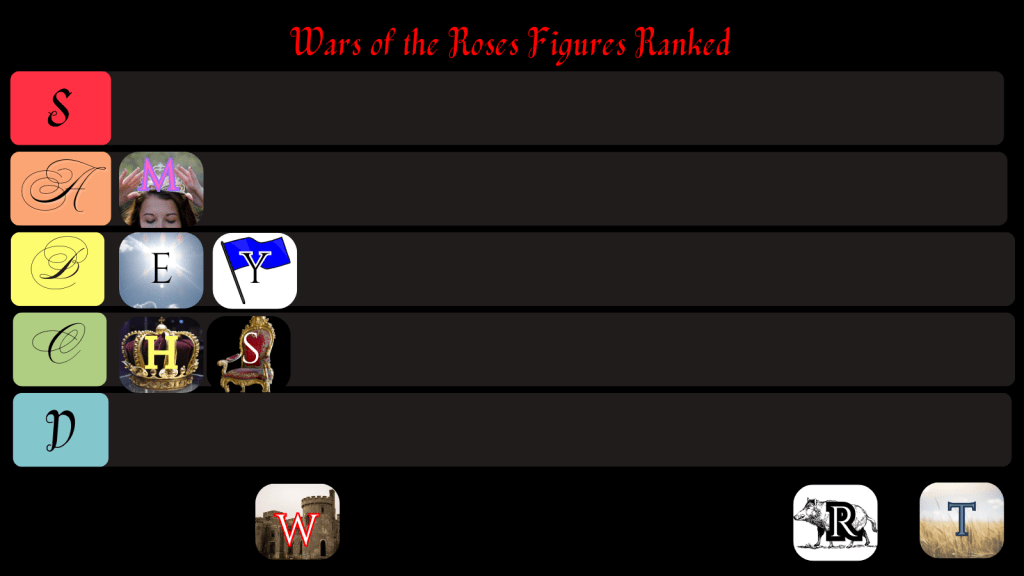
Somerset is such a hard one to place. His success rate was high, but ultimately he paid for being Henry’s favorite with his life. During the Wars of the Roses, at least, he wasn’t a very good warrior, and his personality is honestly really hard to pin down. I feel like his warrior skills and personality outweigh his success, so I’m going to have to place him in the C category.
What do you think of my ranking? Do you think it’s accurate, or would you have placed him somewhere else? What fact do you find the most interesting? Personally, I am fascinated by the spy ring. How do you think I’ll rank the next historical figures? Let me know in the comments below! ~ Kay Adelin
Discover more from Kay Adelin
Subscribe to get the latest posts sent to your email.


3 thoughts on “Ranking History: The Wars of the Roses Historical Figures: Somerset”