


Today is the fourth of my eight day series where I rank a group of eight historical figures on a scale of S to D (superb to terrible) based on how well they succeeded in their duties and/or goals, their skill in battle, and by what we know (if anything) about their general personalities as normal people.
Previously, we have covered Henry VI, Edward IV, and Queen Margaret. Today, we’re covering the man who perhaps started it all: Richard, Duke of York. As always, these are just my opinions. You may have an entirely different perspective–and if you do, feel free to share it in the comments!
Richard, Duke of York
Richard of York is a controversial figure. Some say he was pushed to the edge and forced to drag the nation into the Wars of the Roses. Others seem to think he fomented the wars by his own desire for power. Both may be right, from certain points of view. One thing is clear, however. Richard of York was not aiming to usurp the throne, at least, not initially.
When we look at Richard of York’s success level, we have to take into consideration many things, especially his goals during the Wars of the Roses. York was Henry VI’s cousin, but the two weren’t close. Henry favored his Beaufort cousins, including the Duke of Somerset, but, at first, it didn’t seem too obvious. After all, he had another favorite before Somerset: the Duke of Suffolk. During Suffolk’s rise to power, Richard, Duke of York, was given the Lieutenancy of France. This was during the Hundreds’ Years War with France, and, around this time, England was still riding on the tails of Henry V’s victory at Agincourt, though cracks were beginning to show. But York successfully held France steady, despite the Beauforts (specifically the Duke of Somerset) and Henry VI undermining his authority. When his commission as lieutenant of France expired, none other than Somerset replaced him. York was given the Lieutenancy of Ireland instead, and seemed to carry out this successfully as well–while under Somerset’s leading, English power in France crumbled.
In 1450, several popular rebellions, Suffolk’s murder, and other serious events occurred. York, hearing about them in Ireland, decided to return to England, unannounced, to help. Henry, however, had Somerset at his side, and did not wish for York’s help. York, in essence, considered Somerset the root of the problem–under Somerset’s leadership, English authority in France crumbled, and now, again under Somerset’s leadership, English authority in England was crumbling. York tried multiple times to unseat Somerset as Henry’s chief advisor and nobleman, and while he briefly succeeded on occasion, such as when he seized control of the government in 1453 and imprisoned Somerset, these victories were short lived. Somerset always managed to return with Henry’s backing. And despite eventually killing Somerset at the First Battle of St. Albans in 1455, York never did manage to reach his goal of becoming Henry’s most trusted advisor.
In fact, the First Battle of St. Albans essentially created blood feuds amongst Henry’s supporters and York’s supporters, and, perhaps from fear and desires of vengeance on both sides, groups began gathering armies. Queen Margaret finally managed to find a reason to label the Yorkists as traitors in 1459, and York was essentially, in this case, forced to press his right to the throne. In autumn of 1460, York succeeded in getting himself and his sons named Henry’s heirs, but a little over two months later, York and his second son were killed at the Battle of Wakefield. However, that very next summer saw his son Edward crowned king.
So while York had several successes (his lieutenancy of France and Ireland, and obtaining the rights of succession for himself and his sons), what I would say his main goal was (not usurping Henry’s throne but merely becoming his most trusted advisor) he failed in miserably. And ultimately, he never got to see the results of his most recent success, his family sitting on the throne.
So I’ll have to give him a four for his personal success. Mostly because he failed so horribly in his main goal, he helped create a bloody conflict that lasted for years.
As for being a warrior, York honestly seemed more inclined toward the political machinations of court than the physical battles in the fields of England. His nephew Warwick, Warwick’s father Salisbury, and York’s son Edward seemed to be the ones York relied on to clear the way for him.
York did raise plenty of armies, though, and was certainly recognized as the leader of the Yorkist faction. In 1452, York raised an army to pressure Henry to agree to some reforms, including removing Somerset from power. However, York was tricked or otherwise forced to disband his army. In 1455, York fought at the First Battle of St. Albans and was victorious, but it was Warwick who truly led the men to victory. In 1459, York raised yet another army with his allies, but a betrayal caused him, Warwick, Salisbury, and his two sons Edward and Edmund to flee to Calais and Ireland, leaving his army, town, and wife and two youngest sons at the mercy of Margaret’s army. And when he finally returned to England after Warwick, Salisbury, and Edward paved the way in 1460, he traveled to Wakefield where he was killed.
Honestly, writing this all out makes me see that York just wasn’t the brightest and best military leader, and I think he knew and respected that by delegating the more warrior-like tasks to his brother-in-law Salisbury, nephew Warwick, and Edward. But he was popular and could gather the armies and be recognized as their head despite never actually leading in a successful battle (save for the First Battle of St. Albans). So I’ll have to give him a five, merely for his ability to raise the armies and delegate them to people he know could win battles for him.
From the above, I think it’s clear that York was quite intelligent, despite not being the best at leading successful battles. He did manage to take control of the kingdom three times (once in 1453 when Henry’s illness rendered him incompetent, briefly in 1455 after the First Battle of St. Albans, and finally when he secured the right of succession for himself and his sons) and all three times took an immense amount of political maneuvering.
One thing York seemed good at during all these times of power was trying to be both bipartisan and frugal–during 1453, he gave many of his political enemies grants of land and offices while those closest to him received nothing, and in early 1456, he tried to pass the Act of Resumption where lands given recklessly away by the crown would be returned to it to bolster the kingdom’s finances. This act ultimately failed and York was forced to resign as a result of it.
Yet another example of his attempts at bipartisanship was during 1450, when rebels in his name attacked Somerset. Supposedly, York himself ordered two of his allies to rescue Somerset, which they did. Some, however, believe the ease with which they rescued him only proved York was behind the whole affair and sought to make himself look good.
However, York was also excellent at making himself a nuisance, and one has to wonder if he had not existed in the equation of mid-1400s England if the Wars of the Roses would have happened. While it appears like York was constantly attacked by Henry’s favorites, York himself may have fomented the attacks first by condemning Somerset of treason, a serious accusation, and by pushing to make himself Henry’s heir in 1451. He also fled in 1459 and left his town, men, wife, and youngest sons at the queen’s mercy, a humiliating and horribly dishonorable thing in that time and ours. And it’s still a mystery today why York chose to fight when he did at the fatal Battle of Wakefield, a battle which really should not have been fought and which seems contrary to both York and Salisbury’s usually steady, conservative natures.
I have to say in light of his attempts at bipartisanship and mostly intelligent political maneuvering, though, and his attempts at actually reforming the government, he seemed like quite a steady, intelligent man, willing to act in unconventional ways in order to reach his goals. So I’ll give him a seven for personality, as he seems like he would have been a decent king–more than Henry or Edward, in my opinion.
Success: 4
Warrior Skills: 5
Personality: 7
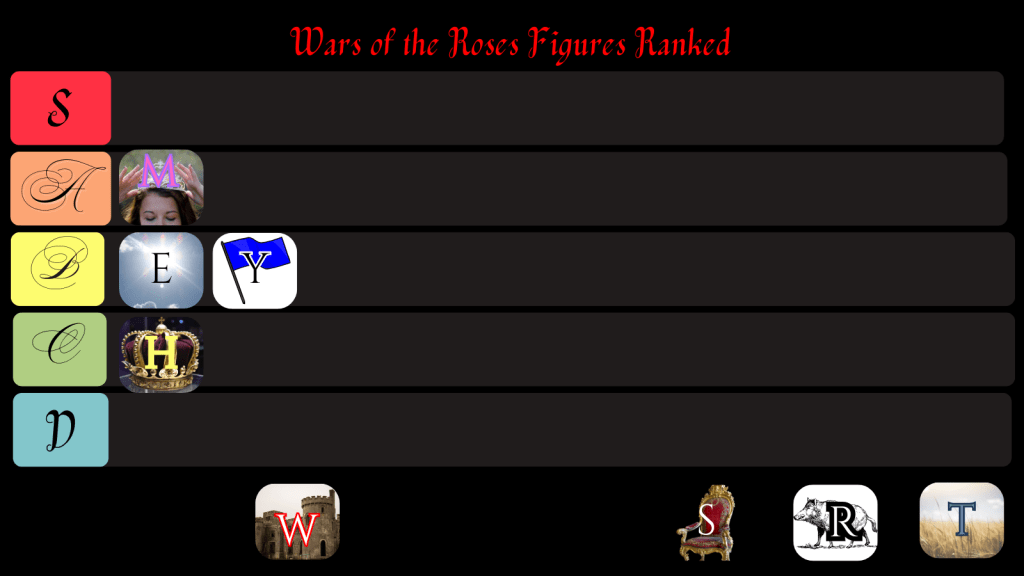
Richard, Duke of York, is a controversial figure. While he had several successes and appeared like he’d be a decent ruler, he never seemed to be able to hold onto his successes, and while a bright political mover, he wasn’t the best warrior. I think this warrants him a place in the B column alongside his son. Like father, like son, right?
What do you think of my ranking? Do you think it’s accurate, or would you have placed him somewhere else? What fact do you find the most interesting? How do you think I’ll rank the next historical figures? Let me know in the comments below! ~ Kay Adelin
Discover more from Kay Adelin
Subscribe to get the latest posts sent to your email.

 Kay Adelin
Lots of interesting topics here! I find it interesting how you pointed out his goal being to become Chief Advisor as opposed to becoming King; gives me things to think about for the more politically-focused series I’m planning.
Thanks for another great post! Really excited to see your opinions on the others!
LikeLiked by 2 people
Yes! I feel like that’s one of the biggest misconceptions about the Wars of the Roses, that they were originally and always a dynastic dispute, when in reality, it was far from that, at least in origin!
Oooh now you’ve got me curious! You’ll have to tell me about this series someday!!
Thank you for reading and commenting!!
LikeLiked by 1 person
Ooh this is such an interesting topic! I’m learning so much about the Wars of the Roses! Thank you so much for this information 😁
LikeLiked by 1 person
Thank you!! I’m so glad you’re enjoying them! 😁😁
LikeLiked by 1 person