

Last year, I read a whole encyclopedia on the Kings and Queens of Britain (the review of which you can read here!) and I do believe it has birthed a new interest in medieval historical non-fiction for me! That encyclopedia inspired me to read this one on knights also by Charles Phillips, and while I still liked the other encyclopedia slightly better, this one was full of awesome facts and featured a whole section on King Arthur and some of his knights–which I’m absolutely obsessed with.
The Synopsis (Taken from Goodreads)
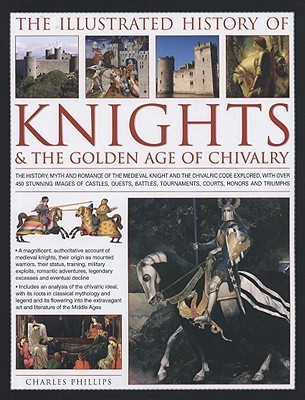
A magnificent account of the medieval knight and the chivalric code, with over 450 images of their quests, battles, tournaments, triumphs, courts and castles In battle, the medieval knight was the equivalent of the modern tank. A knight could plough his way through ranks of foot-soldiers, and on massive warhorses in tight formation, a cavalry charge was devastating. This book describes how the order of the knight began, and the training that noble-born sons underwent to achieve knighthood. There are features on King Arthur, medieval poetry and courtly romances, stories of the crusaders, and folktales of rogue and errant knights. The world of the medieval knight is brought to life with over 450 images that illustrate the castles, quests, battles, loves, tournaments and triumphs of these legendary heroes.
Personal Review
As I mentioned above, I did enjoy this encyclopedia a lot! They covered a range of topics, from the basics of becoming a knight, some historical knights, knightly legends, chivalric deeds, and knightly orders–pretty much a little bit of everything!
I really enjoyed the section explaining the process a man had to go through in order to become a knight–from the early days as a page, to an esquire, and finally becoming a knight and what all usually went into that ceremony–assuming one was not just knighted on the battlefield. This was quite helpful for me, since I’m writing a medieval fantasy story about an esquire which I’m hoping to keep as historically accurate as possible in my fantasy world.
Of course, my next favorite section was on the knights of King Arthur. Arthur himself, along with Sir Tristam (and Isuelt), Sir Kay, Sir Eric, Sir Lancelot, Sir Galahad, and Sir Gawain each get two pages dedicated to them. Sir Percival gets four (lucky guy) and Sir Mordred gets one, while Sir Bors and Sir Bedivere share a page. Despite being short, the brief excerpts they give on them are good for someone who maybe isn’t as familiar with the legends as I am–and it’s neat because they take stories from some of the older legends as well, not just Malory’s version. And they do have interesting insights on some of them I never would have thought of!
The little excerpts they had on real knights were probably my next favorite–I do love reading about actual figures over just random facts, which I think is why I liked the other encyclopedia on Britain’s royals just a little better–but I really enjoyed how here, we got to hear about knights who weren’t just royals, but also some who arose from poorer stations to make names for themselves.
However, I had a couple minor issues with the encyclopedia. In some excerpts, I felt they mentioned things but didn’t expound as much upon them as I would have liked–like, if it warranted a mention, at least give me a little information on it. This connects to my second issue as, in most cases, they provided no sources for further reading. And furthermore, a few things they claim as fact, I’ve heard debated by other historians. That being said, they did quote a few of the medieval sources, so it’s not entirely sourceless and most of the stuff they do state without giving sources for (at least that I know) is stuff that is pretty widely supported by most other historians.
But for just wanting a brief overview without going super in-depth into the intricacies of the evolution of Medieval Armor, let’s say, this encyclopedia is a super fun and easy read! I highly recommend it for someone who’s mildly interested in the subject of knighthood and/or doesn’t have much knowledge on the subject. It makes for a great springboard to looking deeper into aspects of knighthood or its legends, battles, or heroes which one might want to research further about.
Like my previous review on the encyclopedia on the Kings and Queens of Britain, I shall be listing some of the interesting facts I discovered while reading this encyclopedia!
The Knighting Ceremony
Being a writer with several esquire and knight characters, it’s nice to know what the general, ideal knighting ceremony was supposed to look like. While probably not every esquire was knighted in this exact way, this was the way Geoffroi de Charny gave as ideal in his Book of Chivalry (c.1350).
On the day before his knighting ceremony, a squire would bathe, then rest in a bed with pure white sheets. At the given hour, other knights would come and dress him in white linen, a scarlet robe, black stockings, a white girdle and a scarlet cloak. Each of these elements had a specific religious meaning associated with them.
The knights would then lead the knight-to-be to a church in the evening to have a lonely vigil–a night in prayer. In the morning, the knights would return and accompany him to Mass, where he should pray for divine grace to make him fit to be a knight. Afterwards, the actual ceremony began, as the knights would lead the squire into the presence of the knight who was to knight him. This knight would attach a gilded spur to the knight-to-be’s foot, gird him with a sword, and kiss him to confirm the conferral of knighthood, before dubbing the squire and giving the famous accolade everyone associates with one becoming a knight.
Brothers-In-Arms Process
I always thought two knights becoming brothers-in-arms was similar to modern military men becoming “brothers in arms”. They live together, eat together, and fight alongside each other, through the thick and thin. And while that’s partially true in the medieval version of this concept, the medieval knights often took this a step further–by making oaths and actually writing them down like an actual contract.
The process went like this: Two knights would pledge loyalty to one another unto death, promising to support each other in war and peace, fight together, and defend each other. Oftentimes this was formalized in a written document, and as part of the procedure, the two would take Holy Communion, mix their blood, and then exchange the “kiss of peace”. This oath was stronger than any other tie that bound them except for their feudal duty to their lord or king. It even took precedence over a promise to their ladies.
Emperor Frederick I‘s Accidental Fake Death
Apparently, at the battle of Legnano, Emperor Frederick I, known also as Barbossa, was thrown from his horse and left for dead. His guard and standard bearer were killed beside him, and it seems the army, assuming he was also dead, fled. When they returned home, they told Barbossa’s wife that he was dead and for three days they mourned–until he suddenly showed up unannounced where they were, having recovered enough to travel there from the battlefield, very much alive.
Sir Bors as the Antithesis of Sir Mordred
The encyclopedia only had a short section on Sir Bors–less than a half a page. However, they made the interesting observation that Sir Bors, the holy knight who was able to succeed on the Grail Quest with Sir Galahad and Sir Percival (and the only one to survive and return home) was the antithesis–or exact opposite–of the villainous Sir Mordred. This is something I’ve never really thought of–and now it’s made me curious. Someday, when I have spare time, I might go through and compare and contrast the two, just to see how true this may, in fact, be.
Medieval Helmet Evolution
Initially, medieval helmets just wore a hood of chain mail with a padded cap beneath it, but by the 13th century they had an actual helmet with a flat upper surface and tiny holes in front of the nose and mouth so the knight could breathe. Curved-topped helmets came into use shortly thereafter, as “experience had shown” this type of helmet deflected blows better than a flat-topped helmet.
These are just some of the fun facts I learned about in this encyclopedia! I highly, highly recommend this encyclopedia to anyone who’s mildly interested in this time period and/or has little to no knowledge about it! It’s a great springboard to find interesting figures, battles, and legends to study more in-depth!
Personal Rating: 4.5/5 Stars
Did you know any of these facts? Which was your favorite? Do you have a certain time period which is your favorite? What is your favorite fact about a knight or medieval battle? Do you have a good historical fiction with knights recommendation? Let me know in the comments below! ~ Kay Adelin
Discover more from Kay Adelin
Subscribe to get the latest posts sent to your email.

 Kay Adelin
One thought on “May Read: The Illustrated History of Knights & the Golden Age of Chivalry”